- For Enquiry -
- +971 509267126
- +971 551207626
- enquiry@optioneducation.ae

IT Admin1
Introduction to Algebraic Expressions
Algebraic expressions are the cornerstone of mathematics, serving as a fundamental building block for solving equations, making predictions, and understanding complex relationships. In this comprehensive guide brought to you by Option, we’ll delve into the fascinating world of algebraic expressions, uncovering their significance and utility in various aspects of life.
What is Algebraic expression
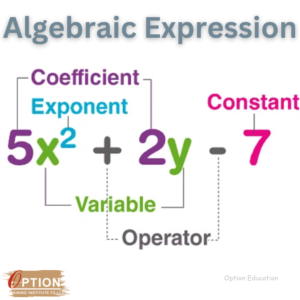
Algebraic expressions are fundamental mathematical representations used to describe relationships and perform operations in algebra. They comprise variables, constants, and mathematical operations such as addition, subtraction, multiplication, and division. These expressions are used to model real-world situations, solve equations, and simplify complex mathematical problems. Here’s a brief overview of key components and concepts related to algebraic expressions:
The Power of Algebraic Expressions
Algebraic expressions are incredibly versatile and applicable in numerous fields such as science, engineering, economics, and more. Understanding algebraic expressions allows you to:
- Solve real-world problems.
- Make informed decisions.
- Predict outcomes.
- Analyze data.
- Simplifying Algebraic Expressions
Simplifying algebraic expressions is a crucial skill that Option will help you master. We’ll provide step-by-step techniques and examples to simplify even the most complex expressions, making your mathematical journey smoother and more enjoyable.
EQUATION:
A mathematical statement in which two expressions are equal and set on either side of an equal sign:
VARIABLE:
A symbol (often a lower-case or upper-case letter) that represents one or more numbers. For instance, in the equation a+b=c+5, a, b, and c are variables.
When an equation includes a variable, the numerical value of that variable, which makes the equation true (makes the two sides equal), is called the solution to the equation. An equation may have more than one solution, or it may have no solutions.
CONSTANT:
A fixed value. In Algebra, a constant is a number independently, or sometimes a letter such as a, b, or c to represent a fixed number.
Example: in “x + 5 = 9”, 5 and 9 are constants.
COEFFICIENT:
A Coefficient is a number used to multiply a variable (4x means 4 times x, so 4 is a coefficient).
Variables on their own (without a number next to them) have a coefficient of 1 (x is 1x).
INEQUALITIES:
An inequality shows that two mathematical expressions are NOT equal.
Inequalities are used to show that one quantity is greater than (>), less than (<), greater than or equal (≥), less than or equal(≤), or not equal (≠) to another quantity.
Example:
10+x≥ 9 (means “any quantity that is ten greater than x is greater than or equal to nine”.)
Solving inequalities is much like solving equations but with one very important exception: “When solving inequalities, reverse the direction of the inequality sign whenever you multiply or divide the inequality by a negative number.”
ALGEBRAIC WORD PROBLEMS
When encountering an algebraic word problem, convert the sentence into expressions by converting words that indicate relations and operations into symbols.
Examples include:
- “is” means “=”
- “more than,” “the sum of,” and “increased by ” mean “+”
- “less than” and “the difference” mean “-“
- “the product of “ means “×”
Always begin by examining the question for structures and expressions with more than just a single variable or number that will help manipulate the equations. Most questions will contain such a structure, and difficult questions may require you to recognize a question’s structure to answer the question at all.
An Important strategy to approach this type of question uses the property of equality to isolate the variable on one side of the equation and solve it. Confirm the solution by plugging the value back into the original equation.
When working with an equation or inequality with more than one variable, solving for one variable will often be necessary. Certain questions will ask you to do only this. To solve for a given variable, transform the equation or inequality to isolate the variable on one side of the equation. This variable is then expressed in terms of the other variable(s).
5 STEPS TO FOLLOW:
- Read the problem carefully and determine what values you are trying to find.
- Assign variables to unknown values if appropriate; Make a sketch.
- Write an equation or equations that represent(s) the relationship among values.
- Solve the equation or equations.
- Check any solutions in the context of the problem.
Conclusion
Algebraic expressions may initially seem complex, but with Option’s guidance, you’ll unlock their potential and discover how they can simplify your life and enhance your problem-solving abilities. Join us on this educational journey and take your understanding of algebra to new heights.
Start your algebraic expression adventure today with Option.
At Option Training Institute, Dubai, Training for tests such as the SAT and ACT is a planned exercise that aims to make math learning enjoyable and productive.
Option Training Institute offers the most generous platter of course types for training for Digital SAT, ACT, AP, UCAT, and LNAT and hence has a course/schedule for everyone! Join our Classes for comprehensive and personalized guidance tailored to your academic goals. For information you can contact us.